Thursday, March 29, 2007

U.S. military foils insurgent attack with water truck and dump truck

Herald News Daily - link

U.S. military foils insurgent attack

Staff and agencies
27 March, 2007

BAGHDAD - U.S. soldiers foiled two suicide truck bombings against their base in a small town west of Baghdad and killed as many as 15 attackers, the U.S. military reported Tuesday.

The military said 30 insurgents responded with small-arms fire, rocket-propelled grenades and mortars. Five minutes into the firefight, a dump truck following the same path as the exploded water truck tried to smash into the base but the driver was shot and the load of explosives blew up.

Tuesday, March 27, 2007

California driver named Goodyear's Highway Hero for 2006

LOUISVILLE, Ky. — Goodyear’s 24th North America Highway Hero Edward A. Regener, of Perris, Calif., escaped one fire and jumped into another to save the lives of two men trapped in their burning car.

The FedEx Freight truck driver scrambled from the passenger door of his damaged cab; a burning pickup truck was lodged against his driver’s door, blocking an easy exit. To make matters worse, his twin trailers contained hazardous materials that would contribute to the spread of a toxic fire.

Incredibly, thanks to Regener and some other motorists, all lives were saved.

Regener, a 13-year veteran truck driver, was named the 2006 Highway Hero here March 22 at the annual banquet of the Truck Writers of North America held in conjunction with the Mid-America Trucking Show. His quick thinking on Interstate 10 near Phoenix on Nov. 4, 2006, assuredly saved his life and the lives of two men who caused the tragic accident.

Regener was chosen from four finalists. The other finalists included:

• Elizabeth Pavlista of Miami, Ariz., driver for B.J. Cecil Trucking Inc. Pavlista rescued a woman from her burning car after it rolled down an embankment on Arizona 177 on Aug. 8. The woman died from her injuries.

• Richard Miner, of Phoenix, driver for Saia Motor Freight. Miner saved a woman’s life when her car crashed, rolled and burned in the Interstate 10 median near Phoenix on Sept. 28.

• Marlon Marum, of Burnsville, Minn., driver for Con-way Freight. Marum saved a Metro Transit police officer who was attacked by a drug suspect in downtown Minneapolis on Oct. 6.

For a full report on the award, including an interview with Regener, see the April 15 issue of The Trucker.

For more on Goodyear’s Highway Hero program and to nominate a truck driver for the 25th anniversary of the award, go to http://www.goodyear.com/truck/whatsnew/hero_overview.html.

The Trucker News Services

Sunday, March 25, 2007

San Bernardino County Sun - Early alert for forest

Early alert for forest - Dry winter poses wildfire risk
George Watson, Staff Writer

Earlier this month, officials celebrated cutting down the one millionth bug-killed tree in the San Bernardino National Forest.

It was a moment of understandable celebration because of the vast scope of the work: Trees had been dying at a high rate over the past decade, filling the overgrown forest with what are essentially standing matchsticks ready to explode.

For more than three years, dead and ailing trees have been coming down at a rate of 750 per day, boosted by a $70million grant from the federal government.

But as the sun shined brightly on another uncommonly warm March afternoon, the circumstances of that day's weather caused some concern.

"Normally, firefighters would be packing sandbags right now," said David Stuart, a mountain resident and leader of the nonprofit group Rebuilding Mountain Hearts & Minds, which was born out of the devastating 2003 Old Fire that destroyed nearly 1,000 homes. "Instead, they are filling up their pumper engines."

There's been little reason to make sandbags for residents to place around their homes for protection against heavy rainfall.

People used to talk about the region's fire season.

Traditionally, it lasted from June when temperatures rose and moisture levels plummeted - to late November, when rain tends to fall in the valleys and snow blankets the San Bernardino Mountains.

Those days are becoming a memory.

The reasons are twofold: a warming trend further drying out an arid region thanks to a Mediterranean climate that provides little moisture; and population growth in traditionally rural areas that are difficult to defend from wildfires.

Despite the rain that fell in recent days, Southern California is heading toward a historic low in rainfall.

Normally, this time of year is a favorite for flower enthusiasts. But the lack of any real sustained moisture has left the mountains and deserts devoid of their typical spring blooms - another sign of the region's dryness.

It's also a foreboding indication of this year's wildfire season, because the blooms are critical for retaining moisture and holding off the dry season that normally wouldn't start for a month.

"We've seen this coming for the past several years," said Pat Dennen, chief of the San Bernardino County Fire Department.

Historically, the county Fire Department has requested $500,000 to pay for supplemental, temporary firefighters for the fire season.

"This year, we left them in place because we never really got out of fire season," Dennen said.

Dennen doubted he would ask for additional funds above the $500,000 for the next fiscal year, which begins July 1.

The reason? He credited the county Board of Supervisors for consistently beefing up his full-time roster of firefighting jobs over the years.

Like the county, the California Department of Forestry and Fire Protection has been readying for year-round firefighting.

Following some then-uncharacteristic wildfires in winter months during the mid-1990s, CDF officials began looking at how the fire season was changing.

The department is in the second of a three-year trial program that is keeping some fire stations open year-round, said Bill Peters, a CDF spokesman. Those stations are in and around San Bernardino, Riverside and San Diego.

Normally, stations like those in Chino Hills and Phelan would shut down during the wetter, winter months, Peters explained.

"Now, the bulk of them are left open with an engine crew stationed there," Peters said, estimating that about 60 percent of stations have stayed open.

Yet while the firefighters are there to battle wildfires, their main responsibility during the winter months is prevention inspections, he added.

"Our inspections are going up exponentially," Peters said, explaining that by making homes and properties safer, it reduces a wildfire's destructive abilities. "The Legislature wanted to see how it was working, making sure they got their money's worth.

"I'd say it's working out pretty well."

Water Truck on Stunt production

'Stunt Junkies' stages bridge feat
Discovery Channel production films parachute drop, BASE jump at Foresthill span

"Stunt Junkies" stunt athlete Jonathan Tagle approaches the Foresthill Bridge on Friday after swooping from 4,000 feet. The other canopy chute belongs to camera operator J.C. Colclasure. Photo by gus thomson/ Auburn Journal

The always-photogenic Foresthill Bridge became a drop zone for Discovery Channel's "Stunt Junkies" on Friday.

Stunt athlete Jonathan Tagle, a world champion two years ago in canopy parachute piloting, was the "Stunt Junkies" star - attempting a death-defying drop that started 4,000 feet in the air from a helicopter.

Tagle's job was to "swoop" his chute for a landing on the bridge, discard the rigging, jump off the bridge for a free fall and then open a second BASE-jumping chute for a landing on the American River canyon floor about 730 feet below.

Tagle admitted to a "respectful nervousness" leading up to the jump. The bridge is the third highest in the United States. Tagle, 38, has racked up 5,000 parachute jumps and 50 BASE jumps. But he had never done a combination of the two. It will also be his first time on "Stunt Junkies," when the episode airs in May.

"This bridge has a lot of respect in the BASE community," Tagle said. "I'm a little bit nervous but that's what keeps you in check. You use it in a positive way."

"Stunt Junkies" host Eli Thompson, who has 14,000 jumps, said the bridge adds an extra dimension to stunts like Tagle's. The BASE acronym stands for buildings, antennae, structures and earthbound locations parachutists jump from.

"The bridge is fantastic," Thompson said. "It's a favorite of BASE jumpers and I wish it was a legal place to jump, like the one in Twin Falls (Idaho). BASE jumpers are courteous and what better use for the bridge than that."

Last week's three-day shoot at the Foresthill Bridge, about a half-mile east of Auburn, was the third visit by "Stunt Junkies" in the last six months to the pea-green span.

Filming in October provided preparatory footage for bungee jump at Colorado's Royal Gorge. Last month, stunt athlete Marta Empinotti attempted a BASE jump from the top of a moving truck over the bridge railing. That show is slated to air April 16.

Over the past decade, Foresthill Bridge filming has included a spectacular Corvette drop for the Vin Diesel action movie "XXX" and several other stunts for reality-based TV shows.

The "Stunt Junkies" production team approached Placer County and the state Parks Department two weeks ago for a film permit and OK to jump off the county-owned bridge into the canyon, which is part of the Auburn State Recreation Area.

Beverly Lewis, director of the Placer County-Tahoe Film Office, said that working with executive producer Perry Barndt provided an extra level of security when it came to safety.

"He's one of the top stunt coordinators in Hollywood," Lewis said. "He's the perfect person to pull this together because he doesn't take any chances. There are very few things we say 'yes' to filming."

The shoot provided work for Auburn-area people. Lewis said a water truck to wet down the temporary helicopter pad was from Foresthill. The helicopter and pilot were also from Foresthill. And the "Stunt Junkies" crew spent an evening unwinding Thursday at Bowman's Foothill Bowling Center.

Chopper pilot Erik Vandagriff, of Richvale'sa A&P Helicopters, flew from the temporary helipad with a copter that featured four different cameras to catch all the action.

A Foresthill resident who has previously worked on motion pictures like "Independence Day," Vandagriff said that with Placer County not charging for film permits, locations like the Foresthill Bridge are attractive to production companies.

"We need to promote this for the county - when filming at the Golden Gate Bridge costs $15,000," he said. "This is our backyard and we have so many locations."

BCNG Portals Page

AIR QUALITY More water used to quell problem


By JEREMY DEUTSCH
Observer Reporter

Mar 25 2007

It’s not unusual for air quality in Quesnel this time of year to get bad.

As the snow melts, dust from dirty roads and parking lots fill the air and reduces air quality.

So the city is requiring property owners with parking lots to water their lots before they’re swept.

“What we’re asking them to do is use some water to wet it down prior to sweeping, to keep the dust down as they sweep,” director of public works Jack Marsh said.

“I don’t think it’s a big onus on people.”

Marsh said the city has been using water for a few years when cleaning streets.

“We send a water truck ahead of it, we wet down the road-then we sweep it,” Marsh said.

Marsh said the city hasn’t required private parking lots to use water in the past, but every little bit helps keep the air clear.

With its Airshed Management plan, Quesnel’s Air Quality Roundtable is keeping tabs on air quality problems.

“There is some improvement in air quality in the area, but not a great amount,” AQR chair Dora McMillan said.

“It’s a very, very slow process.”

McMillan hopes property owners will follow the bylaw.

“I’m hoping they will, because it really is a health issue,” she said.

“We all have to work together to clean the air.”

McMillan said March and April are the worst months for air quality.

McMillan points to a study from Prince George due out later this year, on health effects related to dust and chemicals mixing in the air, as proof of how important the issue is.

McMillan will be presenting a report on an update of air quality in 2006 at Nature Education Resource Centre April 11 at 7 p.m.

Marsh said it usually takes six to eight weeks for crews to clean the entire city.

The city started a couple of weeks ago.

“We got a pretty good jump on it for this early in the year,” Marsh said.

Sunday, March 18, 2007

A water truck crashed into the side of a mountain

10:00 PM PDT on Saturday, March 17, 2007

The Press-Enterprise

A water truck crashed into the side of a mountain Saturday in the Running Springs area, injuring the driver and blocking traffic lanes until he could be freed from the wreckage.

The accident happened about 6:05 p.m. on Highway 330, near Hunsaker Drive, said Bonnie Curtis, dispatch supervisor for the San Bernardino County Fire Department.

California Highway Patrol officers and firefighters from Running Springs, Lake Arrowhead, San Bernardino and Highland all responded to the crash scene, where rescue crews finally extricated the truck driver about 8:30 p.m., Curtis said.

Paramedics airlifted the victim to Arrowhead Regional Medical Center in Colton, she said.

--Mary Bender

mbender@pe.com
Water Trucks and Water Tenders

Monday, March 12, 2007

Water Truck sprays street on big job!

City tearing up E. Brundage Lane

Collapse of sewer trunk line spurred $7.8 million monthslong project

| Sunday, Mar 11 2007 9:25 PM

Last Updated: Sunday, Mar 11 2007 9:27 PM

If your daily ramblings take you along East Brundage Lane, you've no doubt noticed a massive project that's ripped open more than a mile of roadway east of Union Avenue.

Photos:

More than a mile's worth of East Brundage Lane is torn up east of Union Avenue for replacement of a city sewer trunkline. Last week, Richard Nicholson of Griffith Co. mixed grout for a new manhole near Cottonwood Road.

The city is replacing four miles of antique sewer trunk line -- vintage 1912 -- that collapsed in December 2005, said Jack LaRochelle, Bakersfield's assistant director of public works.

When finished, new pipes will stretch below Brundage from Mount Vernon Avenue to L Street, then jog north under L to California Avenue.

The old system's collapse at Mount Vernon and Brundage about a year ago Christmas prompted replacement of the whole line, LaRochelle said.

The $7.8 million effort kicked off Oct. 16 and is expected to be finished around midsummer, said Conchita Walker of public works' engineering division. So far, a strip from Mount Vernon to the west of Washington Street is finished, she said.

These days, crews from Griffith Co. work a 1.3-mile-long dirt span running down the center of East Brundage.

The action should delight any construction junkie -- especially kids in the tractors-are-cool phase -- even as it frustrates motorists.

Tuesday afternoon, for example, utility workers labored neck-deep in a gouge at East Brundage and Cottonwood Road. They'll temporarily relocate gas lines and other equipment to make room as crews replace the sewer trunk line around them.

Overhead, the traffic light blinked red as drivers at the busy intersection rolled tentatively through a confusing jumble of cones. A water truck made regular passes up and down East Brundage, taming loose dirt with its twin spray.

Richard Nicholson, one of Griffith's employees, mixed grout in a bucket to apply to a new manhole west of the intersection. Near Union, rows of long pipe awaited deployment.

Pipe diameters run 36 inches to 42 inches, said LaRochelle. The PVC pipes -- polyvinyl chloride, a type of hard plastic through which sewage flows easily -- are encased in concrete, he said, which provides a solid structural barrier.

The city has another major sewer project slated to break ground in a few weeks, LaRochelle said.

A 6-foot diameter trunk line to serve all of northeast Bakersfield will be planted mostly under currently unbuilt roads on its way to treatment plant No. 2, located north of Planz Road and west of Mount Vernon. The so-called "northeast interceptor" project will ring at around $16 million to $20 million, LaRochelle said.

Both projects are being paid with city sewer fee money, he said.


Water Trucks and Water Tenders

Sunday, March 11, 2007

The Way Of The Freak

The Way Of The Freak: "Sunday, March 11, 2007

Home

This is such a strange neighbor hood. First off, there's a movie crew just down the street filming "Untraceable" starring Diane Lane. We live on the corner and starting the next block is a movie set. Big trucks, generators, mobile snack van, makeup artists, lights, etc. They had the street light up like no one's business the other night when filming went on till 4:00 am. It seems, they do a lot of set up, break down, and standing around, only briefly punctuated by actual filming. No wonder these movies cost so much money. The thing that really cracks me up is the fact that after scrubbing and pressure washing the side walk and path to the movie house, they decorated it with leaves and branches not unlike those they so meticulously removed. Also the idea of using a water truck to wet Portland city streets in the rainy season is very amusing.

Then, this morning while finishing some art and music projects, we were greeted with the sound of bagpipes. The Saint Patrick's Day parade! Irish wolfhounds a plenty, people dressed in green, and both the big fire trucks from our local Company 13.

Every time we get disgusted with the dope fiends, the shopping cart people, or the sad state of our aging building, somethings like these come along that make living here all worthwhile. All below our living room window .

Tuesday, March 6, 2007

Jefferson County Fire District #1 Culver Station - Firehouses on Waymarking.com

Jefferson County Fire District #1 Culver Station - Firehouses on Waymarking.com: "HyperLink View waymark gallery
Jefferson County Fire District #1 Culver Station
Posted by: Groundspeak Premium Member Volcanoguy
N 44° 31.627 W 121° 12.605
10T E 642228 N 4931979
Quick Description: Jefferson County Fire District #1 Culver Station in Culver, Oregon.
Location: Oregon, United States
Date listed: 3/6/2007 12:51:13 PM

Long Description:
The Jefferson County Fire District #1 Culver Station is located at 200 First Street, Culver, Oregon 97734. This station has a quick attack rescue/light brush engine, a heavy brush engine, a structure engine, a water tender, and a utility vehicle.
Paid or Volunteer: Part Paid / Part Volunteer

Number of Firetrucks: 4

Web Address: Related Website

Physical Address:
200 First Street
Culver, OR United States
97734

Monday, January 22, 2007

4,755 gallon Close Support Tanker For Water (CSTW)


4,755 gallon Close Support Tanker For Water
Cab Seating:
3-person

Axle Configuration: 6x6

Curb Weight (VCW): 28,000 lbs (12,700 kg)

Gross Combined Weight Rating: (GCWR): 122,000 lbs (55338 kg)

Fifth Wheel Vertical Loading: 32,000 lbs (14515 kg)
Length: 297.4 in. (7554 mm)
Width: 98 in. (2489 mm)
Height: 140 in. (3556 mm) Reducible to 98 in.
(2489 mm) with preparation
Track: 80.8 in. (2052 mm)
Wheelbase: 184 in. (4674 mm)
Maximum Speed: 65 mph (105 km/h)
Tires: 16.00R20 XZL Michelin
Wheels: 20 in. x 10 in. (508 mm x 254 mm) two piece bolt
together, steel disc
Central Tire Inflation System: Standard
Fifth Wheel: Fully oscillating with 2 in. SAE kingpin capability
(3.5 in. optional)
Fuel Capacity: 78 gal. (295 liters)
Cruising Range: 300 mi. (483 km)
Fording: 60 in. without kits (1524 mm)
Transportability: •C5, C17, and C141 aircraft (w/preparation)
• CH53 Helicopter at VCW
• Shipboard crane loading at VCW
Engine:
Caterpillar®, C-12 electronic control, 425 HP
Transmission:
Allison 4700SP, automatic electronic control
Transfer Case:
Oshkosh 30000 Series
Suspension:
Oshkosh TAK-4™ independent suspension system
Electrical System:
24 volt vehicle with 12 volt/10 amp accessory
in cab, 12/24 volt trailer attachment, 150 amp alternator
Brakes:
Anti-Lock Brake System with automatic traction control
Steering:
All wheel mechanical steer
Turning Diameter:
60 ft. curb to curb

Axles:
(2) BPW Model 10110 E36.1 Eco Plus tubular non-driving axles
2 x 22,046 lb. rating
82.5 in. track width
Brakes, Service:
BPW S-Cam, air-operated, drum type brakes with internal shoe
Brakes, Parking and Emergency:
BPW S-Cam spring brakes on first axle
Interlocked with pumping system
16.5 x 7.9 in.
Gross Weight:
58,422 lbs.
Electrical System:
24-volt with road legal lighting and convoy lights
Kingpin:
SAE 3.5-inch (89 mm) dia. with a 70.7 in. design height
Pumping Module:
Self-priming stainless steel centrifugal water pump
264.2 gal./min. capacity
Piping:
Stainless steel, welded construction with flanged
or threaded connections
Trace heating elements on manifold prevent freezing
Self-cleaning
Manhole:
(2) 19.7 in. dia. hinged fill covers
Overall Length: 408.3 in.
Suspension: BPW air suspension on two axles
Tank:
4,755 gal. capacity, single compartment tank with two lateral
baffles and two longitudinal baffles
Cylindrical and conical sections with domed ends constructed
of cold-rolled AISI 316L stainless steel with a .18 in. tank shell
Contents gauge with external reading display is standard
Insulation: 4 inches surrounding tank, stainless steel clad
Tires:
Michelin® 16.00 R20 XZL
One spareWater Trucks and Water Tenders

Fire in Taj banquet hall water tenders save building

Fire in Taj banquet hall
Short-circuit suspected; firemen take 30 mins to control blaze; lobby, kitchen damaged

Express News Service
Chandigarh, January 21:

Fire broke out in the banquet hall of Taj GVK this evening, creating panic in the area. Though there was no casualty, a portion of the five-star hotel’s lobby, kitchen and banquet hall suffered damage. The exact cause of the fire could not be ascertained till late night, but according to fire officials it seemed to be the result of a short-circuit in the banquet hall.

The fire, which started around 3.55 pm, was brought under control in about 25-30 minutes, but the fire-fighters had a tough time detecting the source of thick smoke, which had engulfed the hotel lobby on the ground floor and even upper floors. As many as 43 rooms of the hotel were occupied at that time. All the guests and other visitors were evacuated immediately.

While a few guests were transferred to Hotel Mountview, others refused to leave without their belongings. They were seen hanging around as the fire-fighting operations were in progress.

“Because of the structure of the hotel building, there was no exit for the smoke. We had to break the lobby glasses. After conducting a thorough check, we restored electricity at about 7 pm, after which the hotel staff started cleaning operations,” said one of the fire officers.

Besides four water tenders, a Bronto skylift, water-boozer, exhauster and other fire-fighting equipment were used in the operation carried out by around 35-40 fire-fighters. Ishwar Dass, the leading fireman, fell unconscious because of the thick smoke. He was admitted to General Hospital, Sector 16, where he was given medical treatment.

In-house fire-fighting system ‘Inadequate’
z The fire has raised questions on the in-house fire fighting capabilities of the hotel. The guests said they didn’t hear any fire alarm when the fire broke out. “The hose reel and hydrants inside the hotel didn’t function also didn’t function,” said Fire Officer JS Kang. When asked whether the NOC of the hotel will be suspended because of this “inadequacy”, Fire Officer cum Joint Commissioner H.S. Khandola, said: “It will be too harsh to suspend the NOC of the hotel because of this incident. Now that everything is in control, we don’t think that the suspension is required.” Guests ‘harassed’
A number of guests who were asked to evacuate were seen worried about their luggage and other belongings left inside. Jake, a tourist from Chicago, complained that no fire alarm was used. “I was working on my laptop when someone knocked at my door and informed me about the fire.” Another guest had a worse experience. “When I got a call on my mobile that there is fire on the ground floor, I rushed downstairs, but got lost as the exit signs were not clearly marked. The hotel staff were more confused.” Taj GVK general manager Anil Malhotra said they didn’t use the fire alarm “because they didn’t want to create a panic”. “It was just smoke and there were no flames. We are trying to find out the cause of fire. Except a few glasses that were broken to give a way out to the smoke, nothing else got damaged or burnt. The banquet hall, it seems, won’t be functional for some time. Our hotel’s coffee shop, all restaurants and bar have started functioning as usual,” he said.


Water Trucks and Water Tenders

The Tactical Fire Fighting Truck from Oshkosh


The Tactical Fire Fighting Truck from Oshkosh is engineered like no other. It combines the superior mobility of the Oshkosh HEMTT M977 with the unmatched firefighting capabilities of Pierce fire apparatus. The TFFT is a multi-functional vehicle that's ready to deploy whenever and wherever needed for aircraft rescue, fuel storage protection, structural firefighting, wildland firefighting, rescue, extraction and homeland defense missions.

The TFFT from Oshkosh Truck Corporation puts you in command.

Military Grade Fire Fighting Power.
The tough and rugged Tactical Fire Fighting Truck (TFFT) is
engineered like no other vehicle on the planet. It combines the
superior mobility and military prowess of the Oshkosh® HEMTT with
the #1 firefighting vehicle in the world, Pierce. The result is a
multifunctional crossbred vehicle that’s ready to deploy at a
moment’s notice for any severe aircraft rescue, fuel storage
protection, structural firefighting, wildland firefighting and rescue
extrication in almost any terrain.
Go mobile.
Wherever support is needed, from off road to no road, the TFFT will
get you there. Built on an incredible 210-inch (5.33 m) wheelbase,
it features all-wheel drive, a 445 hp (335.97 kw) engine and is rated
at 60 percent gradability at GVW. Its cruising range is 400 miles (640 k),
and fording clearance is 48 inches (121.92 cm).
Tough as nails.
Proven, severe-duty HEMTT components are standard throughout
the TFFT, meeting the highest levels of Oshkosh quality and reliability.
The body is constructed of high impact galvanneal steel, with a
unique steel support system. Pierce installs corrosion resistant
stainless steel plumbing for a long, durable life and easy
maintenance. Firefighting plumbing is stainless steel for longer life
and proven corrosion resistance. One of the key advantages of the
Oshkosh-produced HEMTT and the TFFT is the easy access and
interchangeability of major parts within the vehicle series.
In addition, systems are designed for accessibility, making routine
maintenance quick and easy.
Go to battle in full gear.
The TFFT cab and crew quarters can carry six firefighters; five in full
SCBA gear. The TFFT is equipped with a 1,000-gallon (3800 l) water
tank, 2,000 feet (608 m) of hose, 1,000 gpm (3800 lpm) pump, and
roof and bumper turrets with in-cab remote controls. There are
generous storage compartments for carrying everything needed
onto the scene, including a hydraulic generator, TNT® rescue tools,
saws, air-lifting bag kit, extrication equipment, and EMS equipment.
We’ve got your back.
Oshkosh Truck Corporation backs the TFFT with worldwide,
on-demand parts and service support 24/7/365.


Typical specifications

CHASSIS
• HEMTT M977 chassis
• Wheelbase: 210 inches (5.33 m)
• GVWR: 66,000 lbs.
• Engine: Detroit Diesel Model
8V92TA/445 (335.97 kw), 12.1 liter DDEC IV
• Transmission: Allison HD 4560
• Transfer case: Oshkosh 5500 series
• Front and rear axles: Standard HEMTT
tandem axles, LHS springs on rear
• Tires: 16R20 XZL Michelin®
(8 + 1 spare) tubeless
• Electrical system: Standard 24 Volt
HEMTT
• Gradability: 60% @ maximum GVW
• Maximum speed: 62 mph (100 kph)
• Operating temperature: -25° F/+125° F
(-40° C/+51.6° C)
• Fuel capacity: 155 gallons (586 liters)
• Fording: 48 inches (121.92 cm)
• Air transportability: C17
FORWARD CAB
• Two-person, passenger seat with
SCBA provisions
• Intercom
• Heating and air conditioning system
• Firefighter radios
CREW QUARTERS
• Four-person seating
• Four SCBA seatbacks
• Intercom
• Heating and air conditioning system
• Firefighter radios
FIREFIGHTING SYSTEMS & EQUIPMENT
• 1,000 gpm (3800 lpm) single-stage
Darley pump, driven by a Deutz 200hp
diesel engine
• Two 2.5-inch (6.35 cm) outlets (left side)
• Two 2.5-inch (6.35 cm) outlets (right side)
• Two 60-gallon (228 liter)
polypropylene plastic foam cells
• Class B foam system (liquid fuels)
• Class A foam system (wildland and structure)
• Pump and foam controls inside cab
• Pierce galvanneal steel fire body
• 1,000-gallon (3785 liter) water tank
• Hose capacity: 400 feet (121.92 m) of
1-3/4" (4.45 cm); 1,200 feet (365.76 m)
of 3" (7.62 cm); 400 feet (121.92 m) of
2.5" (4.45 cm) DJ hose
• Roof turret/monitor and front bumper
turret/monitor controls in cab
• 500 gpm (1892 lpm) roof turret/monitor
• 250 gpm (946 lpm) bumper turret/monitor
• Under-truck foam nozzles
• Windshield deluge system
• Two 1.5" (5.71 cm) preconnects in the hosebed
• LED lighting
• Two hard suction hoses
• Six air bottle compartments
• Ladders: one 24-foot (7.31 m) two section
ladder, one 14-foot (4.26 m) roof ladder
• One 10-foot folding ladder
• Electric ladder rack
• 15 kw hydraulic generator
• Telescoping lights
• TNT rescue tools
• Various saws
• Air-lifting bag kit
• Extrication equipment
• Wildland tools
• Nozzles
• EMS equipment

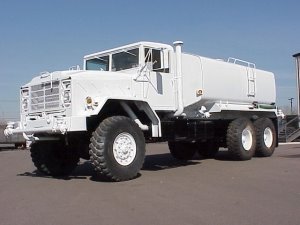
Water Trucks and Water Tenders

Tactical fire fighting water tender news stories

Tactical water tender stationed at Fort Carson Fire

Vehicles engineered to support Tactical Fire Fighting Trucks

Pierce
Awarded Contract To Build New Water Tenders For U.S. Army
JUNE 27, 2006, Appleton, Wis.
– Pierce Manufacturing Inc. has been awarded a low rate initial production contract by the U.S. Army Tank-automotive and Armaments Command (TACOM) for the production of four Oshkosh® Heavy Expanded Mobility Tactical Truck (HEMTT) platform-based Water Tender (HEWATT) vehicles. The vehicles will be delivered in December 2006 and January 2007.


The trucks are designed to provide structural and airfield crash-rescue support alongside the Pierce® Tactical Fire Fighting Truck (TFFT). The HEWATT is engineered to operate over varied terrain, ranging from firm ground to soft soils, and under extreme conditions. The HEWATT water tender is built to support the TFFT while providing supplementary fire suppression capabilities.

"This contract signifies a significant step in our growing relationship with TACOM in our ability to provide new product and meet the military’s needs,” said Jim Parker, vice president government sales and homeland security at Pierce Manufacturing. "The new water tenders are also an excellent example of the shared technologies employed by Pierce and our parent company Oshkosh Truck Corporation to build a vehicle that delivers tremendous performance and outstanding value."

The HEWATT Water Tenders are each equipped with a 2,500 gallon integrated water tank, Detroit Diesel 455 hp electronic engine, two-person seating, 8’ x 8’ axle configuration, Oshkosh two-speed transfer case, Allison five-speed automatic transmission, bolt together wheels and a corrosion protection upgrade package.

Pierce Manufacturing Inc., a subsidiary of Oshkosh Truck Corporation [NYSE: OSK], is the leading North American manufacturer of custom fire apparatus. Products include custom and commercial pumpers, aerials, rescue trucks, wildland trucks, mini-pumpers, elliptical tankers, and homeland security apparatus. In addition, Pierce designs its own foam systems and was the first company to introduce the Side Roll Protection™ System to fire apparatus. To learn more about Pierce, visit www.piercemfg.com.

Water tender - From Wikipedia, the free encyclopedia

Water tender
From Wikipedia, the free encyclopedia

A water tender is a specialized firefighting apparatus designed for the sole purpose of transporting water from a water source to a fire scene. Water tenders are capable of drafting water from a stream, lake or hydrant.

This class of apparatus does necessarily not have enough pumping capacity to power large hose lines (like a fire engine), though it utilizes a smaller pump to draft from bodies of water. Water tenders are used when there is not a working fire hydrant within reach of other fire equipment, or a water tender gives a possibility to supply the engine(s) with a very rapid connection. Most water tenders are designed to carry loads of 1000 gallons (approx. 3800 litres) or more. Some may carry upwards of 5000 gallons (more than 20 000 litres) of water - with a trailer even more.

Typically water tenders support engines and/or trucks like aerials in fires. Water tenders can be used also in chemical accidents, to clean highways after collisions, or pump water in floods. Some water tenders carry fire fighting equipment and crew resembling more an engine. These water tenders are able to operate relatively independently. As the most ultimate solutions some water tenders really combine a fire engine and water tender. This kind of unit may have seats for up to 6 firefighters, a water tank of more than 3000 gallons (approx. 11 000 litres), and basic equipment for fire fighting and rescue. This kind of solutions are comprehended e.g. in rural areas, where a fire engine (with rescue equipment) and water tender are supported by a combined engine/water tender unit in overlapping fires or accidents.

Very light water tenders are sometimes used in forest fires. For example, a small thank of 265 gallons (1000 litres) is carried by a cross-country vehicle to extinguish smouldering stubs on rough terrain. Some water tenders may carry various kind of hoses utilized in forest, building, or industrial fires. Some tenders carry also foaming agents, and extinguishing powders or gases. Sometimes these materials are carried in very specialized, separate units like hose trucks and powder trucks etc. Specialized Airport Crash Tenders are used at airports to carry larger amounts of water and foaming agents

Water Tender from NWCG Glossary of Wildland Fire Terminology

1. Any ground vehicle capable of transporting specified quantities of water.


Water Trucks and Water Tenders

Sunday, January 21, 2007

Down in the drainage - Canyon Incident

Water Trucks and Water TendersThis picture was shot down along a creek near Boy Scout camp during the Del Puerto Canyon Fire.
This was taken when I was heading out and this LG Strike team firefighter asked me to side spray it and cool it down which I did with front spray head and side deluge head quickly controlling the spot fire. -Canyon Incident


Picture copyright free for non profit ROC 2006


Water Trucks and Water Tenders

From the top of a mountain during the Del Puerto Canyon fire

Nice header from Canyon Incident fire is heading for the San Antonio valley. This picture shows the beautiful goat trails that are considered roads out here.


Top of the world Canyon Incident

Just supporting a long 11/2 mile downhill hose lay for mop up at the Canyon fire.
Water Trucks and Water Tenders

Water Boy's Water tender - Canyon Incident

A picture of the Water Boys water tender staging at the Canyon Incident.

Staging at the Vineyards.

Cool water truck staging at Del Purteo Canyon fire

Cool water trucks is the name of the company, Cool water tender at Canyon Incident.

All Terrain water tender- Canyon Fire - Del puerto

Picture of the backside of the All Terrain water tender rig leaving a hose lay.

Pumping a hose lay - Del Puerto Canyon Fire

Getting briefed on a hose lay at the Del Puerto Canyon fire Canyon Incident CDF Fire 2006

picture copyright 2006 ROC


Water Trucks and Water Tenders

After the head passed

- Firestorm has just passed here and this is where we were originally supposed to be on the fire line Del puerto Canyon Fire near Voice of America transmiters. This is a Cal Hydro water Tender and a real nice Central valley local Government water tender.

The fire got here early...

The fire got here early or we were late picture of "Oh Shit Incident" Plan "B" Execution...

Oh Shit incident - Canyon Fire - Del puerto Canyon

Photo By R. O'Connor CC
Another Del Puerto Canyon "Oh Shit Incident" picture this was not a retreat it was a fast tactical re-adjustment due to prevailing conditions.


fire trail


Feed

Oh Shit incident - Canyon Fire - Del puerto Canyon California 2006

water tender del puerto canyon wildland fireThe true story of the infamous "Oh Shit incident"

Picture from water tender at Canyon Fire ( Del Puerto Canyon )Picture from water tender at Canyon Fire (Del Puerto Canyon)

This was taken out of the window of water tender turning around on a goat trail near the VOA antenna farm during the Del Puerto Canyon fire summer 0f 2006.

We affectionately refer to the subsequent change of plans as the "
Oh Shit incident"
My water tender was part of a water tender strike team with four local government water tenders and a Cal Fire supervisor, we had dozer's somewhere further ahead of us and we had passed some dozer's on the trail/road earlier.

A CDF supervisor, a local government water tender and myself got a bit ahead of the other water tenders going up the steep roads and after a hour or so of driving to the fire the fire meet us apparently with the help of a late morning wind change the fire decided to meet us head on,

just as a real nice local government water tender, a CDF leader, and my water tender reached the top of a saddle at a fire road intersection and temporarily parked to sort out and decide proper staging for the trucks I soon realized the fire was coming up a chimney like draw right at us towards the saddle we were parked on.
I pointed this out to the super and we agreed
Oh Shit it may be time to go somewhere else.

This left very few choices that seemed good!

1.) Up to the VOA site on the top of the fire but a supposedly safe area? but would require driving up a very steep washed out grade which once any water spilled would not only be impassable but life threatening dangerous with the approaching fire and chance of roll over.

Probably was not doable even if half the load of water had been dumped first. Maybe with half load of water and rear lockers or full six wheel drive.

2.) Deploy the trucks in a safe zone right there was the first plan but was soon determined to be too small and unsafe and became a back up plan.

Find emergency fire shelter deployment area in my mind.
Which at this point I was holding in my hand and I had put on every piece of PPE, Nomex, gloves, helmet, goggles everything which we are required to have and more.


3.) Continue along road to large safe area further up which had only one problem associated with it, That was towards the flare up and ran along the crest of the hill above the fire flaming up that side of the hill.

At this point my side spray was pointed directly at the flames coming up the chimney but the Cal Fire Boss wanted to save the water we had just spent hours getting to this area of the fire which was about 30,000 acres at this point. And if you think about it he was escorting over twenty thousand gallons of water to the seat of the fire where it was sorely needed.

Ok it's your water? Whats the plan boss?


In hindsight: We would of probably made it but it would of been foolish.


In hindsight: We would of probably made it but it would of been foolish.


4.) Turn around and go back down the road we just came up and get off the top of the hill to the leeward side of the firestorm.

water tender Del Puerto canyon wild land fire
Sounds good! Lets go! With the Cal Fire Boss leading and then my 2400 gallon truck followed up by a big 5000 gallon Hughson Fire department water tender which is a local central San Joaquin Valley fire department rig we get turned around and head back down the road off the top and right into these water tenders coming up.

So we get turned around headed down hill and right then the other rigs coming up arrive!
Oh
Oh Shit! the other Local Gov water tenders caught up to us!
coming up all on a fire trail with a spotting firestorm on three sides of us..
and behind them a bunch of CDF wild land rigs are coming up.

So the driver of the rig I am now pointed at nose to nose on this narrow road has the biggest "
Oh Shit" look in his eyes and a funny look comes over him as he has just realized he needs to back his rig down this goat path he just drove up while letting the CDF rigs pass by to fight the rapidly approaching fire front which is in the background.

Cal Hydro water tender at Canyon FireCal Hydro water tender at Canyon Fire
Cal Hydro water tender preforming a strategic repositioning maneuver!

At this point backing downhill in front of me are is the rest of the strike team of 3 Local Gov water tenders, a strike team of local government structure protection engines. And the whole time we are trying to find small road side cut outs to let the CDF rigs pass to attack the fire behind us.

Local Gov water tender Oh Shit incident


Oh Shit!

once the bunch of CDF/Cal Fire wildland engines passed us, the crews jumped out and knocked the heat out of the main fire below the
VOA antenna farm during CANYON FIREPicture of VOA Antenna during Canyon Fire


VOA antenna's, residential house and outbuildings at the top. CDF/CalFire made a great stop on a very steep and dry mixed grass, oaks, Chemise and brush terrain and an almost vertical fire line.


View out drivers window spot fire across ridge


View out of water tender, drivers window of spot fire across a small canyon

The fire was spotting badly and rapidly jumping from canyon top to canyon top across the ridge lines...

This fire was a spot fire only minutes beforeThis fire was a small spot fire across a draw only minutes before

After the fire passed our original stopping point and CDF crews had moved further on we got turned around and came right back to the area we had just left,
for now we had returned to ground zero of an fire line event that will always be called the "Oh Shit incident"At this time on my own initiative I began to aggressively fight the small fires still burning in the base of a fence post! unable to successfully extinguish the flames alone due to dehydration I was soon joined in this en devour with the LG tender crews.

Wildland fire pictureWe sized up the situation and reckoned the need to conserve the precious water in the trucks and so we used our own personal God given fire hose and deploying a relay system of "hands on" and directed attacks on the base of the fire successfully saved an old wooden fence post in a timely and very efficient manner.


Original story at Water Trucks and Water Tenders: Oh Shit


Water Trucks and Water TendersFEED